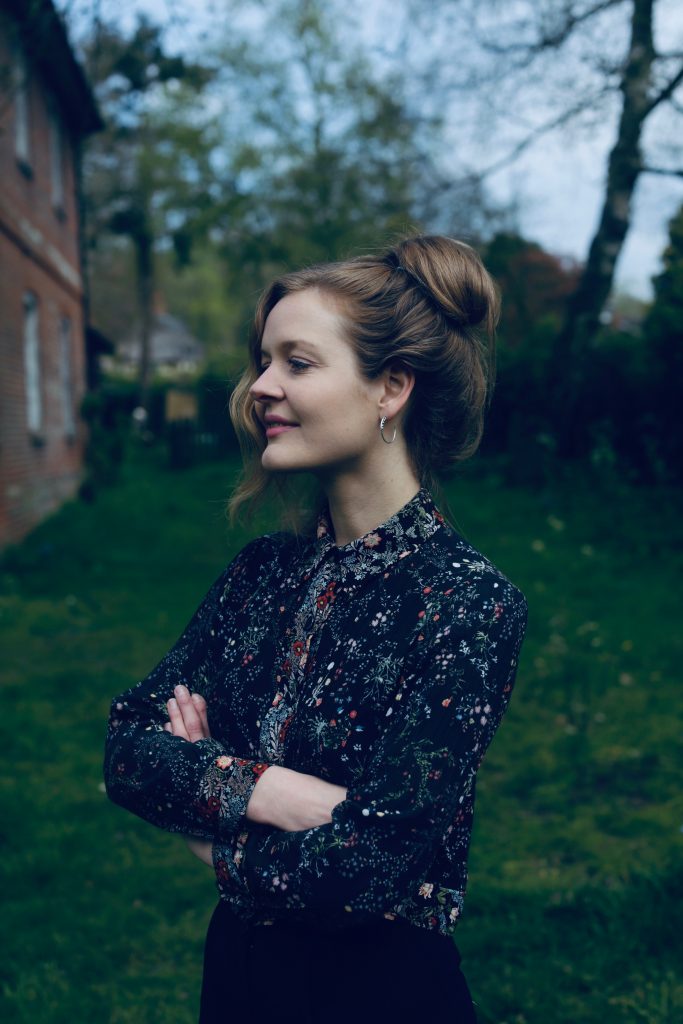
Lily Hunter Green is an interdisciplinary artist and composer working across participatory installation, sound, digital technologies, and ecological systems. Her practice explores how environmental knowledge, scientific research, and more-than-human intelligence can be translated into immersive, collaborative experiences. Through sound composition, interaction, game systems, and responsive environments, she develops works that invite publics to actively engage with ecological processes rather than passively observe them.
Alongside her visual and installation practice, Lily is also a composer and sound artist. Her work has been featured on the BBC World Service, BBC Radio 3, and BBC Radio 4, where her compositions have been broadcast and presented as part of programmes exploring contemporary sound, ecology, and experimental music practice.
Her early practice emerged through experimental sound and audiovisual installations concerned with transformation, material memory, and site-responsive composition. Over time, this developed into a sustained body of work engaging ecological systems and honeybee collective behaviour as compositional and participatory frameworks.
Across subsequent projects including Tuning In, Silencing The Virus, SHE HEALS, and The Blue Halo, her work expanded into increasingly immersive and technologically complex environments combining sound art, robotics, machine sensing, citizen science, AI systems, and collaborative interaction.
These works explore how ecological fragility, pollinator health, and environmental change can be experienced through shared sensory systems that translate scientific processes into participatory public interfaces. They have been presented internationally at venues including the National Gallery, Barbican Centre, Sadler’s Wells, BOZAR, and academic and research-led contexts including the University of Cambridge.
Alongside this body of work, Lily has developed a significant interdisciplinary research practice in collaboration with scientific institutions. Following an artist residency at The Gurdon Institute in 2018, she was invited to become Artist-in-Residence within the Maori Lab, University of Cambridge, where she has worked with researchers on honeybee immunity, virology, and collective resilience. Supported through funding by the Wellcome Trust (2022–2026), this research has focused on translating complex biological systems into accessible participatory artworks and public interfaces.
This led to Hive Heroes, an interactive multiplayer game combining wearable technology, collaborative play, and public science engagement. Developed in collaboration with researchers at Cambridge, the project invites participants to work collectively as ‘worker bees’ to prevent the spread of disease within a simulated hive system. Presented at the Cambridge Festival and Chelmsford Science Festival, it translates contemporary research on honeybee health into an accessible framework for exploring collective behaviour, immunity, and public health through play.
Lily’s research and practice also extends into academic and critical contexts, including contributions to Harvesting Stories: Home and Communities in Thinking Home: Interdisciplinary Dialogues (Bloomsbury Academic), reflecting her interest in artistic practice as a form of eco and social inquiry. She was also artist-in-residence(2017-2020) an Associate Research Fellow(2017-2022) at Birkbeck, University of London.
Her work has also developed through international residencies, exhibitions, and academic engagements, including lecturing and presenting at the Shanghai Academy of Fine Arts, a residency at Secret Hotel Aarhus, participation in group exhibitions at 516 Arts Albuquerque, New Mexico, and involvement in Technarte Bilbao, where she presented work at the intersection of art and emerging technologies.
In recent years, her practice has expanded toward planetary-scale systems and Earth observation through Planet Laboratory, a participatory sci-art platform translating biodiversity monitoring and satellite sensing into collaborative public experience.
The project draws directly on principles of Earth observation and remote sensing, reconfiguring them as embodied, participatory systems rather than distant analytical infrastructures. Through collaborative play, participants negotiate land use, fragmentation, restoration, and ecological balance, transforming environmental monitoring into a shared sensory and decision-making space.
Originally developed through collaborations with the Earth & Space Foundation, Planet Laboratory has been presented across UK and international contexts including Chelmsford Science Festival, the Cambridge Festival (2026), and in Kosovo at the invitation of the British Embassy Pristina, where it was presented at the National Library in Pristina through workshops and public engagement programmes focused on ecological futures and participatory environmental systems.
Across her practice, Lily develops systems that sit between installation, interface, and research platform, exploring how environmental technologies can become cultural and relational infrastructures for collective ecological imagination.